The Opposition and Complementarity of Spirit and Nature
Narcissus and GoldmundThe Opposition and Complementarity of Spirit and Nature names the central distinction Narcissus draws between himself and Goldmund: one is formed by reason, analysis, and the world of ideas; the other by sensation, love, imagination, and the earth. Their difference matters not because one must defeat or convert the other, but because each can learn to recognize and honor what the other is. The principle becomes at once an account of their friendship, a diagnosis of Goldmund’s unawakened life, and a way to understand the contrast between scholarly knowledge and artistic perception.
The Difference Between the Friends
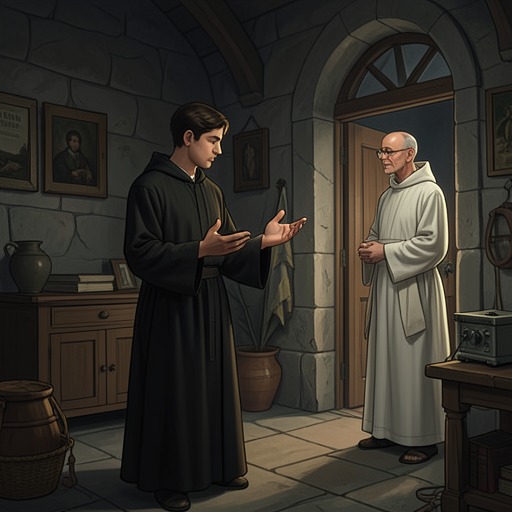
The idea takes shape in a conversation about astrology, a science forbidden in the cloister. Narcissus describes it as an attempt to arrange different kinds of people according to their natures and destinies. Goldmund counters that Narcissus is so intent on establishing differences that he makes the difference itself into a theory. Narcissus accepts the criticism: science, as he understands it, consists in discerning what distinguishes one person from another. The disagreement is not simply over whether people differ. It concerns what kind of knowledge can recognize those differences, and what such knowledge leaves out.
Goldmund argues that visible distinctions—between a peasant and a king, for instance—need no scholar to identify them. He insists that intelligence does not depend on learning and resists the implication that the learned automatically understand other people better. Narcissus clarifies that he is not ranking the friends as more or less intelligent, better or worse; he is describing different natures. Goldmund then challenges the idea that their destinies must differ: they are both Christians, intend to live in the cloister, and share the same religious goal of returning to God. Narcissus answers by distinguishing the equality asserted by dogma from the unequal and particular destinies of actual lives, invoking the contrasting fates of the beloved disciple John and the disciple who betrayed Christ.
The exchange brings the abstract question into the intimate terms of their friendship. When Goldmund says that they will never meet on Narcissus’s line of argument, Narcissus answers that no road will unite them by making them alike. They are, he says, sun and moon, sea and land: opposites and complements whose purpose is to see and honor one another, not to become one another. Goldmund is perplexed and hurt, and asks whether this explains why Narcissus so often seems not to take his thoughts seriously. Narcissus replies that he takes Goldmund himself seriously—his voice, gestures, and smile, and everything in him that Narcissus considers essential—but gives less weight to some of his ideas. His distinction is both an expression of attention and a source of pain: he claims deep regard for his friend while reserving judgment on the intellectual arguments Goldmund wants him to respect.
Wakefulness, Childhood, and Vocation
A later conversation makes Narcissus’s distinction more personal. He defines wakefulness as the ability to know one’s innermost irrational forces, drives, and weaknesses through conscious reason, and to deal with them. He considers himself superior to Goldmund in this single respect, because Goldmund is only half awake, or at times asleep to himself. Narcissus suggests that learning to know himself may be the reason Goldmund met him. In Goldmund, mind and nature, consciousness and dream, remain far apart; he has forgotten his childhood, which still calls to him from the depths of his soul and will continue to make him suffer until he listens.
The words strike Goldmund physically and emotionally. At the mention of his forgotten childhood he flinches, though Narcissus does not notice. As Narcissus continues, Goldmund grows pale, closes his eyes, and asks him to leave. Goldmund recalls having once broken down and wept in front of Narcissus and says that it must not happen again; he cannot forgive either himself or his friend if it does. Narcissus recognizes too late that his eloquence has pierced Goldmund more deeply than he intended. The scene gives the theory a cost: the insight that may help Goldmund awaken is delivered in language that wounds him, and Narcissus’s confidence in his own interpretation does not make him fully attentive to its immediate effect.
Narcissus also reverses the apparent hierarchy between them. He says that the dreamers, poets, lovers, and people of strong, delicate senses are almost always superior to “creatures of the mind.” Goldmund takes his being from mothers, lives through love and feeling, and belongs to the plenitude of life: the fruit’s sap, the garden of passion, the landscape of art. Narcissus, by contrast, describes the intellectual life as arid, at risk of suffocating in an airless void, just as Goldmund risks drowning in the senses. The contrast is not a simple endorsement of instinct over thought. Each nature has its danger; each possesses what the other lacks. Narcissus’s particular strength is wakeful self-knowledge, while Goldmund’s potential superiority lies in a fuller participation in life, once he has found himself.
Nature, Symbols, and the Limits of Scholarship
Goldmund’s account of letters turns the distinction into a difference between ways of seeing. A flower petal or a tiny worm on a path, he says, can contain more than books. A Greek letter such as theta or omega may shift, with a slight tilt of the pen, into a fish or bird, bringing to mind streams, rivers, sea, and sacred waters. To Goldmund, the sign is not merely a stable mark; it can open into images and possibilities. He describes such letters as the means with which God wrote the world.
Narcissus does not dismiss this imaginative transformation. He calls the letters magical and says they can exorcise demons, but distinguishes them from the reliable symbols required for scientific inquiry. The mind seeks definite, solid forms and what is actual rather than possible; it will not allow omega to become a serpent or a bird. It cannot live within nature, Narcissus argues, but only against nature, as its counterpart. Their disagreement therefore concerns more than temperament. Goldmund’s perception discovers continuity between sign and living image, whereas Narcissus’s method depends on keeping distinctions firm enough to study. The same capacity that makes imaginative vision artistically fertile would make it unsuitable for the fixed procedures of scholarship.
Goldmund has begun to accept that he will not become a scholar like Narcissus. He compares his former wish to resemble his father with his changed response after his mother returned to his imagination: the father’s image shrank beside hers, becoming joyless and nearly repugnant. He now tends to regard the products of the mind as fatherly, unmotherly, and hostile to the mother. The language of spirit and nature is thus joined to Goldmund’s recovered maternal memory. Intellectual discipline is not merely an abstract vocation he declines; in his understanding, it belongs to an order that has displaced the source of love and imaginative life he is trying to recover.
The Principle Beyond the Cloister
The novel’s later episodes give the opposition a material setting in which neither solitude nor pure abstraction can sustain a life. When a farmer refuses Goldmund a bed beneath the roof, he does not turn him away entirely: there is hay outside where he can sleep. A shared meal precedes the refusal, and the limited welcome makes the difference between hospitality and security concrete. During a winter departure, Goldmund receives from Lydia a thick gray wool vest and a piece of ham with a gold coin hidden in it. He puts on the vest, conceals the coin, and continues alone through the fields. The gifts become practical protection, but they also remain traces of a relationship carried into his wandering.
The coin’s meaning becomes more acute after Goldmund’s violent flight from Viktor. When he wakes weak in a stable, he realizes that the coin is missing. He values it not simply as money but as Lydia’s one remaining gift, since the vest lies in the forest with Viktor’s blood; the coin had also been the reason Goldmund defended himself against Viktor. Goldmund fears that losing it would leave the terrible night without value. He confides in Christine, who reveals that she found the coin when she laid him on the straw. Her affectionate recognition of his foolishness returns the object to him and, with it, the personal bond and remembered cause that he feared had vanished. The episode complicates the distinction between independence and attachment: Goldmund travels freely, yet objects passed from one person to another preserve relations that his wandering cannot simply shed.
During the plague, Goldmund’s encounter with Robert makes complementarity an immediate matter of survival. Robert sees the bodies in a house and realizes that the plague may have exposed them both. He tries to flee, but Goldmund holds him back and insists that they remain together, since either might fall ill and die. Goldmund promises to bury Robert if he dies and says Robert may do as he pleases if Goldmund dies. Until then, neither is to abandon the other. They find a bucket, milk a cow, and proceed together; from that moment Goldmund commands and Robert obeys, and both fare better. Their cooperation is neither a meeting of identical characters nor a reconciliation of abstract doctrines. It is a practical recognition that each is exposed to the same danger and that one person’s presence can prevent the other from dying alone.
In the birch forest, they find an empty log cabin and make it a shelter. They bring a goat, divide the work, and plan separate rooms: one for Goldmund and Lene, one for Robert and the animal. Goldmund and Lene gather straw, fern, and moss for beds while Robert cuts birch posts for a partition. The makeshift household depends on labor, food, shelter, and the different capacities of its members. Goldmund’s tenderness toward Lene unfolds beside the memory of the plague’s mass graves; the beauty of their brief happiness is inseparable from its vulnerability. The episode gives the novel’s opposition a social dimension: life’s fullness is not secured by an idea of nature alone, but is made temporarily possible through shared work and care amid mortality.
Artistic Work as a Meeting of Mind and Nature
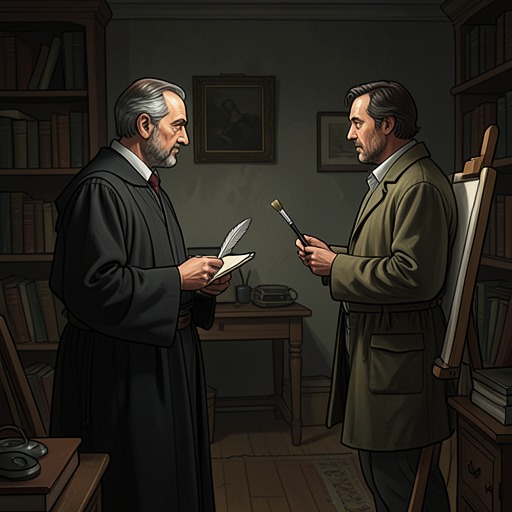
Back at Mariabronn, Narcissus urges Goldmund to clear the obstacles between himself and his works, find or build a workshop, and begin. Goldmund finds an empty shed beside the courtyard gate and turns it into a place of production. He orders a drawing board and tools to exact plans, specifies materials for the cloister’s carters to bring from nearby cities, inspects timber at the carpenter’s and in the forest, and selects pieces to dry beneath a roof he builds himself. The work depends on deliberate planning and material knowledge as well as perception: wood must be chosen, tools made, and a space constructed before artistic creation can proceed.
Goldmund also works closely with the blacksmith and his son Erich. Together they make the knives, chisels, drills, and planes he needs, shaping instruments at the forge, anvil, cooling trough, and whetstone. Erich becomes his friend, helps with the preparations, and is eager to hear about Master Niklaus and the bishop’s city. Goldmund promises to teach him the lute and lets him try carving. In the cloister, where Goldmund can feel useless or depressed in Narcissus’s presence, Erich’s admiration and curiosity revive him. The exchange is reciprocal: Erich assists the artist and receives stories, instruction, and the opportunity to work with his hands.
Goldmund’s workshop therefore does not simply prove Narcissus’s contrast between intellect and nature. It reveals how artistic vocation can bring different kinds of knowledge into contact. Plans and measurements organize a practice grounded in wood, tools, touch, and visual choice; the mind helps prepare the work without exhausting what the work means. Goldmund’s history remains present as well: the hardships of wandering, the plague, and captivity have aged and weakened him, leaving gray in his blond beard, wrinkles, insomnia, and periods of inner fatigue. Yet practical artistic labor and conversation with Erich can make him vivacious again. Spirit and nature remain distinct, but neither is sufficient as an isolated principle: the friendship gives their difference a language, and art turns that difference into a working relation.